

Blepharoplasty | Eye Rejuvenation | Eye Bag Treatment
Eyelid Surgery
We communicate with our eyes; they are the windows to our souls. Occupying a prominent place on our face, they are a feature on which first impressions are formed. As we age, sun, wind, and the pull of gravity all affect the elasticity of the skin. Deep lines and wrinkles begin to emerge around your eyes accompanied by increasing puffiness and heaviness. These changes affect your expression, and people may ask if you are tired, angry or sad, even though that may not reflect how you actually feel. As a result, many begin to seek solutions to restore that open bright-eyed look that conveys youthfulness and alertness. Dr. Julie Edween and her team can provide experienced and precise blepharoplasty solutions in Beverly Hills.
Non-Surgical Rejuvenating with Filler
When shadows and hollows of the lower eyelid area become increasingly visible, restoring volume to the area can bring back youthful contours. Injectable filler products offer an excellent non surgical solution to fill the hollows and restore the contours of the eye for a natural appearance. Commonly used injectable hyaluronic acids fillers such as Restylane, Belotero or Juvéderm can be used off-label to fill in these under eye depressions, recreating the smooth contour from the lower eyelid down to the cheek. Depending on the individual filler, results can last for about six months to about a year.
“I came in looking for an eyelid surgery, but wasn’t quite sure if that is what I needed. She let me know that I could have filler placed in my lower lid, and it looks amazing. Honesty goes far with me, I will definitely have her do my eyes when I am ready.”
MicroFat and Nanofat Injection to Lower Lid
As facial hollows become deeper and gravity pulls, the area of the lower eyelid and cheek can lose volume and descend. For some patients, taking away the fat “bag” will lend to a more skeletonized appearance to the face. In this situation, fat injections can be used to plump up the depression to provide a filled and uplifted restoration to this area. The fat grafts are harvested from an area of excess fat on the body through liposuction, and processed to produce microfat and nanofat grafts, then injected to provide structure and rejuvenation to the depressed area.
Eyelid surgery/Blepharoplasty
Surgery to the eyelids (blepharoplasty) is designed to restore a more youthful look and restore a more wide opened youthful appearance to the eye area. Depending on your anatomy and desired results your plastic surgeon can perform a procedure consisting of upper or lower eyelid surgery or both, and may be combined with a browlift for comprehensive upper face rejuvenation.
Lower Blepharoplasty/Lower Eyelid surgery
Lower eyelid surgery can incorporate several different surgical approaches depending on your needs and desired outcome.
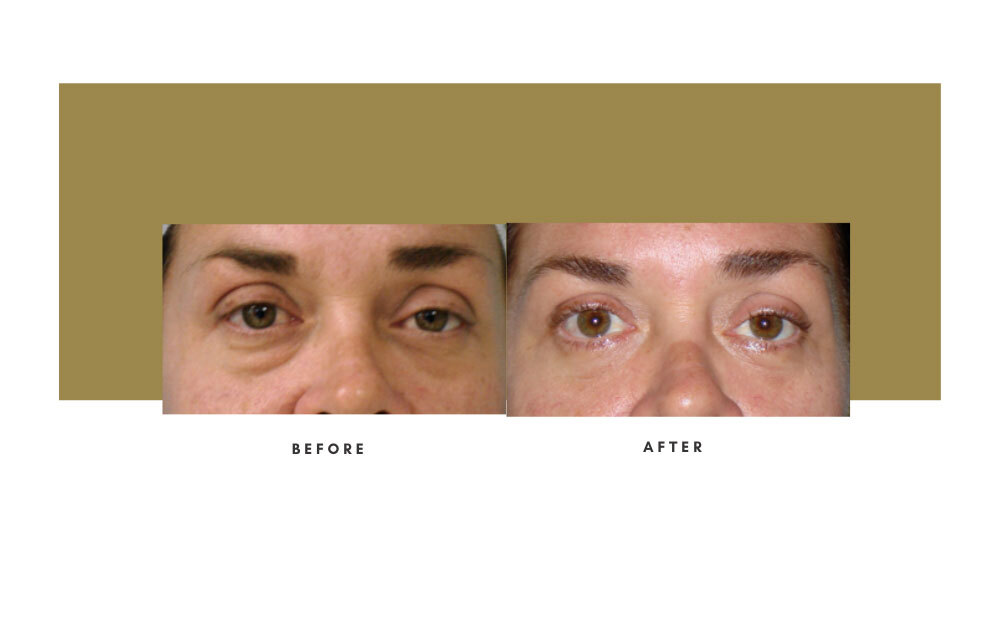
A lower blepharoplasty can rejuvenate the under-eye area by reducing puffiness and bulging. Depending on the severity of the bags underneath the eye, the fat may be removed or redistributed. For a lower blepharoplasty, a small-concealed incision is made within the conjunctiva (lining on the lower eyelid) the excess fat bag causing the puffiness is removed and the slack skin is tightened up through a small carefully placed underneath the lash line. Deeper hollows under the eyes may necessitate adding a fat repositioning procedure or even a fat injection procedure to optimally fill in the shadows or hollows of the eye and rebuild natural youthful contours.



Upper Blepharoplasty/Upper Eyelid surgery
In the aging process of the upper lid one might first notice makeup collecting in the creases of the upper lid, which then develops into hanging skin and eventually advances to the point that it may interfere with vision. To correct a droopy lid, an incision is hidden along the natural folds of the upper lid, and may extend within the natural lateral creases of the lateral crow’s feet or laugh lines. Through this incision the excess fat and muscle is taken to contour the eyelid and loose skin is removed. Fine sutures are used to close the incisions, thereby minimizing the visibility of any scar.


Browlift
The right brow shape can make you look younger and emphasize your eyes. This awareness comes early as much time and effort is spent on tweezing, shaping, and threading of the eyebrows. It’s no surprise that as the brow continues to descend, the heaviness will contribute to a more aged appearance. Reversing the signs of aging is essential, especially in this challenging age where staying competitive with a younger workforce is essential.
If necessary Dr. Edween will combine your blepharoplasty with a browlift procedure to maximize the uplifted results in the upper facial area. A browlift can address the deep creases in the forehead, soften a harsh or angry look and elevate the sag that overhangs the eyes. Even small asymmetry in brow height can also be corrected. The placement of the incision will depend on your hairline and the amount of lift necessary. An uplifted brow position revitalizes the entire eye area, creating a brighter, open eyed and alert expression.
To correct drooping brows and minimize horizontal lines and furrows, Dr. Edween performs brow lifts using small scopes called the “endoscopic brow lift” in contrast to the conventional coronal brow method that involves an incision from ear to ear. The endoscopic surgery involves making tiny incisions in the scalp which are well hidden in the hairline and inserting a tiny, pencil-like camera to view and elevate the muscles and tissues beneath the skin.
If your brow descent is due to volume loss, your own fat can be used as a filler to restore youthful elevation and contours. We naturally loose fat with age, and precisely placing micro and nanofat in replacing in the forehead and temple area is a powerful tool to lift the brow and reshape ones face.
Dr. Edween focuses on natural appearing youthful contours and carefully uplifts the brow into a natural position. It is important to precisely place the brow to avoid the overly pulled or exaggerated surprised looks of the past. The correct placement yields a graceful uplifted youthful appearance to the brows and forehead.
What to expect post Blepharoplasty procedure
- Surgery is performed as an outpatient, and does not require a overnight stay
- An anesthesiologist will provide either a general or IV sedation anesthetic
- You will sleep with your head elevated on a few pillows for the first week
- Cold compresses may be used to reduce swelling and bruising for the first 24-48 hours
- You may experience dry eyes, excessive tearing and sensitivity to light
- You may experience temporary changes in your eyesight such as blurred vision
- You may wake up with crusts and drainage on the outside of your eyes which can be gently cleaned with a 50:50 mixture of saline and hydrogen peroxide
- Upper eyelid sutures are removed in about a week
- Lower eyelid sutures are dissolvable, do not require removal
- After the sutures are removed, use new eye makeup to avoid infection
- Recovery time is in general about 1 week, after which will be able to resume your day-to-day activities. It may take about 6 months for the scars to lose their redness.
Please feel free to contact the office of Dr. Julie Edween if you are interested in a Blepharoplasty/Upper Eyelid consultation. Dr. Edween is dedicated to serve patients in Beverly Hills, Hollywood, and greater Los Angeles, California. You can get started by calling us at (310) 859 8885 today.
For more information about having a blepharoplasty in Beverly Hills California with Dr Julie Edween contact us today.
View our other facial surgery procedures: